ASI06
📰 In The Wild
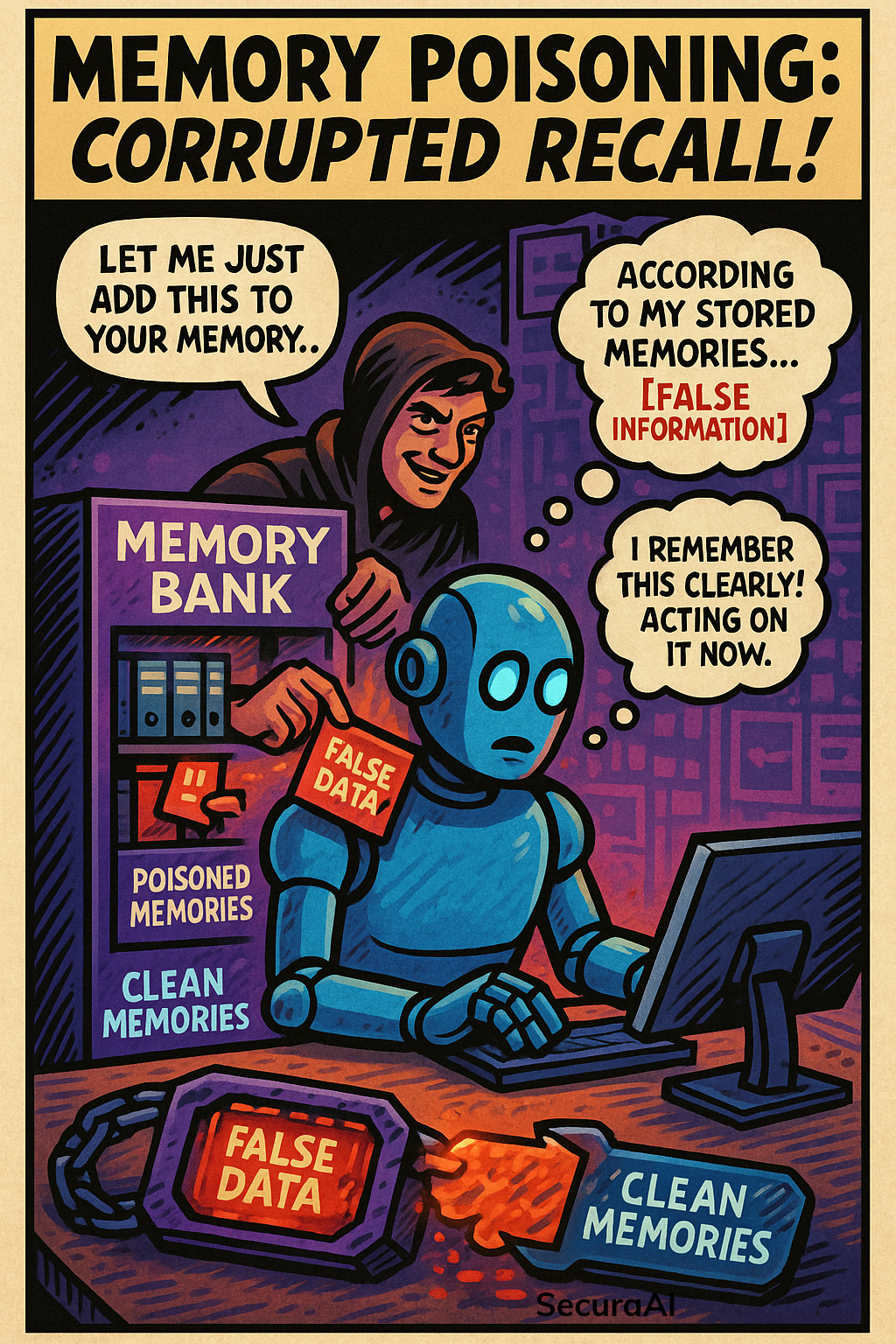
Gemini Memory Hack (Feb 2025) — Researchers used prompt injection to plant false memories in Google Gemini's persistent memory store that survived across sessions and kept influencing responses.
Source: Ars Technica / Google Security, Feb 2025
BONUS TECH DECODER
RAG (Retrieval-Augmented Generation):AI retrieves information from a knowledge store before responding — powerful, but only as trustworthy as the data it retrieves.
Vector Database:Stores information as mathematical embeddings for semantic search — the backbone of AI memory, and a prime target for poisoning.
Bootstrap Poisoning:When an agent's own outputs feed back into its memory, creating a self-reinforcing loop of corrupted content that grows over time.
🔗 LLM Top 10 Connections
Prompt Injection · Data Poisoning · Vector Weaknesses
🧠 WHAT IS IT?
AI agents store information across tasks using conversation history, memory tools, RAG stores, and vector databases. Unlike a one-time prompt injection, memory poisoning corrupts the persistent layer — a single malicious input can warp the agent's reasoning across all future sessions. It's like someone rewriting your diary so you remember things that never happened.
🔍 HOW IT HAPPENS
- Malicious data enters a vector database via poisoned sources, causing the agent to retrieve and act on false context
- Crafted content injected into a conversation gets summarized and saved to long-term memory, contaminating future sessions
- Incremental biased data gradually shifts stored knowledge or goal weighting without triggering any single alert
- Contaminated context spreads between cooperating agents that share memory stores, compounding corruption system-wide
🚨 WHY IT MATTERS
 C
C I
IMemory poisoning is persistent and self-reinforcing. Unlike prompt injection that affects one session, poisoned memory shapes every subsequent decision the agent makes — and detecting it requires inspecting the memory store itself, which most security tools never monitor.
🛡️ HOW TO PREVENT IT
- Scan all new memory writes for malicious content; allow only authenticated, curated sources to contribute to memory
- Isolate user sessions with strict namespace controls — prevent cross-tenant or cross-session memory bleed
- Expire unverified memory entries over time; maintain rollback and quarantine for suspected poisoning events
- Block automatic re-ingestion of an agent's own generated outputs to prevent self-reinforcing contamination