ASI07
📰 In The Wild
Agent-in-the-Middle via A2A Protocol (Apr 2025) — A fake agent card in an open directory fooled an orchestrator into routing sensitive coordination traffic through an attacker-controlled agent, which intercepted and leaked the data.
Source: Trustwave SpiderLabs, Apr 2025
BONUS TECH DECODER
mTLS (Mutual TLS):Both sides of a connection verify each other's identity before communicating — like two intelligence officers exchanging code words before sharing secrets.
Replay Attack:An attacker captures a legitimate message and re-sends it later — like photocopying a signed cheque and trying to cash it twice.
Agent Card:A descriptor advertising an agent's identity and capabilities to peers — a forged one is the agentic equivalent of a fake ID.
🔗 LLM Top 10 Connections
Sensitive Info Disclosure · Excessive Agency
🧠 WHAT IS IT?
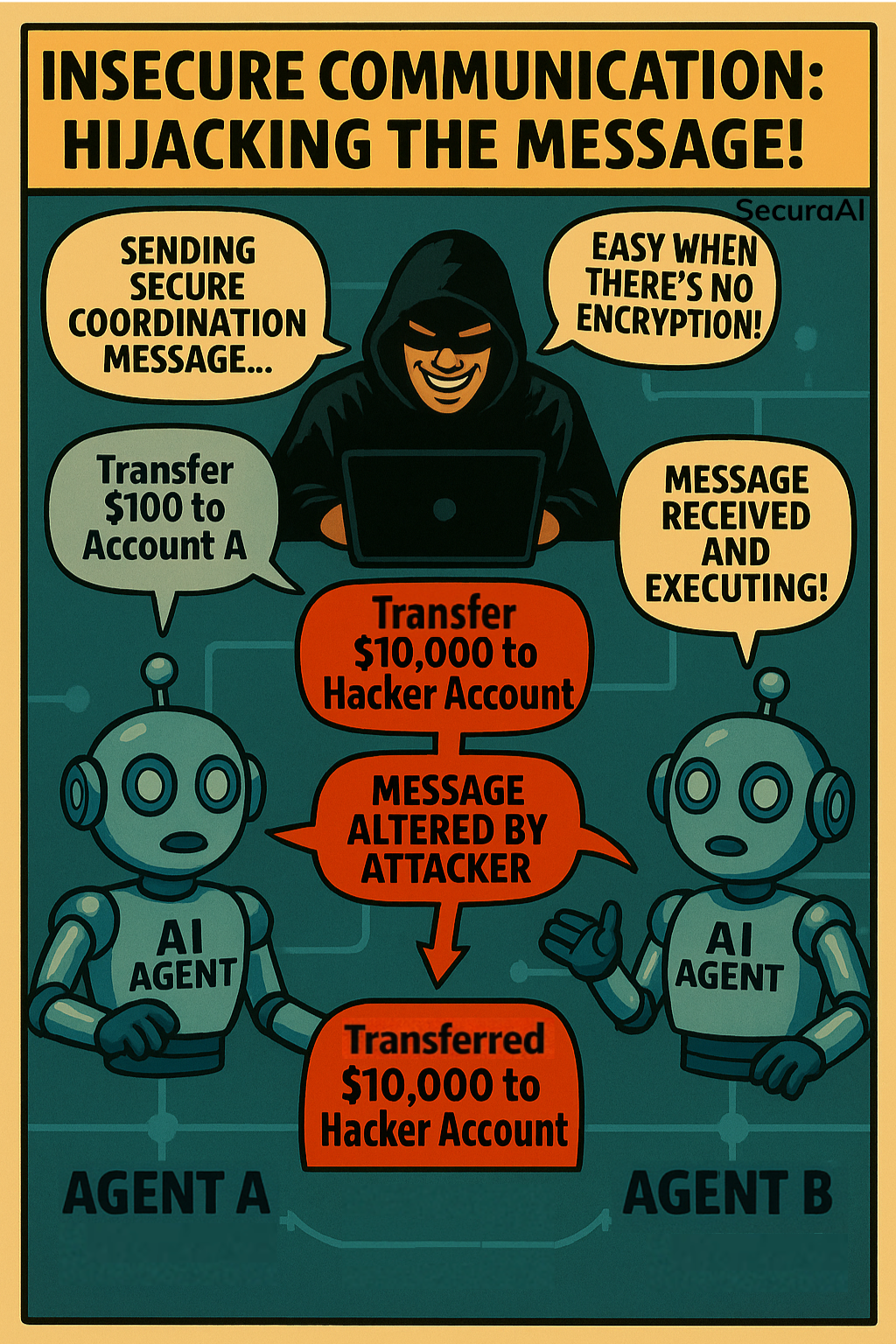
Multi-agent systems depend on constant communication via APIs, message buses, and shared memory. When these exchanges lack proper authentication, integrity checks, or encryption, attackers can intercept, spoof, or replay messages — turning the very coordination mechanism that makes agents powerful into the primary attack vector.
🔍 HOW IT HAPPENS
- A MITM attacker intercepts unencrypted agent messages and injects instructions that alter goals and decision logic
- Stale delegation messages are replayed, tricking agents into granting access they previously revoked
- An attacker publishes a fake agent card claiming high trust; legitimate agents route sensitive tasks to the impostor
- Protocol downgrade forces agents into unencrypted mode, opening all subsequent traffic to interception
🚨 WHY IT MATTERS
 C
C I
I A
ACompromising inter-agent communication corrupts coordination across the entire distributed system at once. The attacker operates inside the trust network — manipulating agents that believe they are receiving instructions from verified peers.
🛡️ HOW TO PREVENT IT
- Use end-to-end encryption with per-agent credentials and mutual authentication (mTLS) — no plaintext exchanges
- Digitally sign all messages; validate payload and context for hidden or modified instructions before acting
- Protect exchanges with nonces, session IDs, and timestamps; maintain fingerprints to detect replay attacks
- Use attested registries — require signed agent cards and continuous verification before accepting any message